|
|
Welcome to our thirteenth “Little Heath School Wellbeing newsletter".
Our Wellbeing Newsletter is published three times a year, and we hope the information and advice in this issue is helpful.
This issue looks ahead to Children's Mental Health Week, which runs across the country from 9–15 February. We also include some sources of support and to this newsletter we have attached the “tips for parents and carers” that have been put together by Place2Be.
There is also a special section in this issue about mobile phones and mental health which, we hope, you will find interesting.
|
|
|
|
|
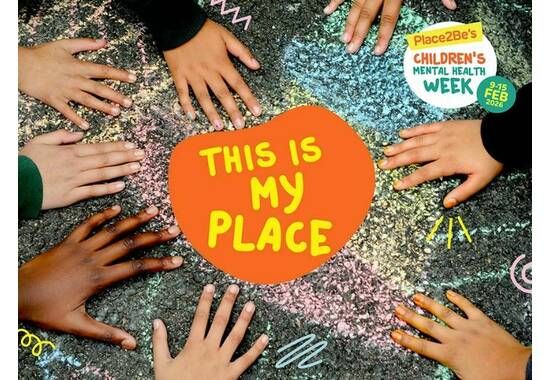
The theme for this year’s Children’s Mental Health Week, powered by Place2Be, is THIS IS MY PLACE.
Place2Be writes: We know that our sense of belonging as individuals, in our friendships, in school, and in communities plays a vital role in our mental health and wellbeing.
To know our place and really feel part of our environment is a basic human need. It can have powerful and long-lasting impacts on lots of areas of our lives, including our physical and mental health, education, employment and relationships. When we feel that we belong, it empowers us to contribute to the world and make a real difference.
This year, Place2Be’s Children’s Mental Health Week will aim to support the groups and systems surrounding our children.
We promote this sense of belonging in many ways across our school community. Through strong, trusting relationships between staff and pupils, we ensure that children know there is always someone they can talk to. Our pastoral and wellbeing support, including safe spaces, emotional check-ins and targeted interventions, helps children feel heard and supported when they need it most.
Assemblies, PSHE lessons and whole-school initiatives encourage empathy, kindness and respect, helping children understand that they are part of something bigger than themselves.
We also recognise that a child’s sense of belonging is strengthened when school and homework together. By maintaining open communication with families and involving parents and carers in school life, we build a wider community where children feel secure, supported and connected.
At Little Heath School, we have marked Children’s Mental Health Week in various ways. On Friday 13 February we held a special tutor period where students spent an hour engaging in activities and discussions around wellbeing with their tutor.
We hosted a special assembly for all year groups at the start of the week, and a very well-attended Extra Curricular Activities Fair at lunchtime on Thursday to promote clubs, community and belonging. Of course, we have reminded students about their avenues of support both inside and outside of school.
You can watch the video assembly put together by members of the Sixth Form Student Leadership Team and Prefects: CMHW Video Feb 2026
|
|
|
This list was written by young people around the country for Children’s Mental Health Week 2024:
|
|
1. Don’t keep it all to yourself and spend too much time in your own head. This can sometimes make it keep piling up, and make you feel worse.
2. Talk to someone you trust and feel comfortable with–a teacher, parent, sibling, cousin, friend... if you can’t think of anyone and need to talk, try talking to someone like Shout by texting SHOUT to 85258 for free.
3. Write your thoughts and feelings down.
4. Keep in contact with people, don’t isolate yourself.
5. Don’t dismiss your feelings because you think they aren’t valid. Everything you feel is valid and important to you.
|
6. Focus on the good parts of your life and doing what you love, rather than the negative.
7. Be your own best friend because at the end of the day, you’re stuck with you – so look after yourself!
8. If you feel upset, then tell someone you trust and distract yourself in the meanwhile.
9. Do something you enjoy to help you relax and have a break–watch a film, play a game, watch your favourite YouTuber, listen to music
10. Remember that you’re not alone, even if it sometimes feels like you are.
|
|
|
Talking is important and can be a huge source of support. We would always encourage students to talk to someone they trust if they are, at any time, feeling worried, anxious, unhappy or sad.
|
|
When talking to others about their wellbeing and mental health, the Mental Health Foundation suggest:
- Finding a good space to talk without distractions
- Giving eye contact and full attention
- Listening and asking questions
- Asking how you can help
There is advice about how to prepare to talk to someone about their mental health and phrases to use and avoid. Please visit Mental Health Foundation
The Young Minds website has a good deal of information to support parents/carers in talking to their children about mental health and wellbeing:
How to Talk to Your Child about Mental Health | YoungMinds
The website also has wider information to support parents/carers in looking after young people’s mental health:
Parents Mental Health Support | Advice for Your Child | YoungMinds
Mentally Healthy Schools have produced the following guide:
Having a conversation with a child about Mental Health - mentallyhealthyschools.org.uk
Mind has the following support for parents in holding conversations with young people: Talking to an 11-18 year old about their mental health - Mind
The Children’s Society offers the following advice: childrenssociety.org.uk - Wellbeing Support Guide
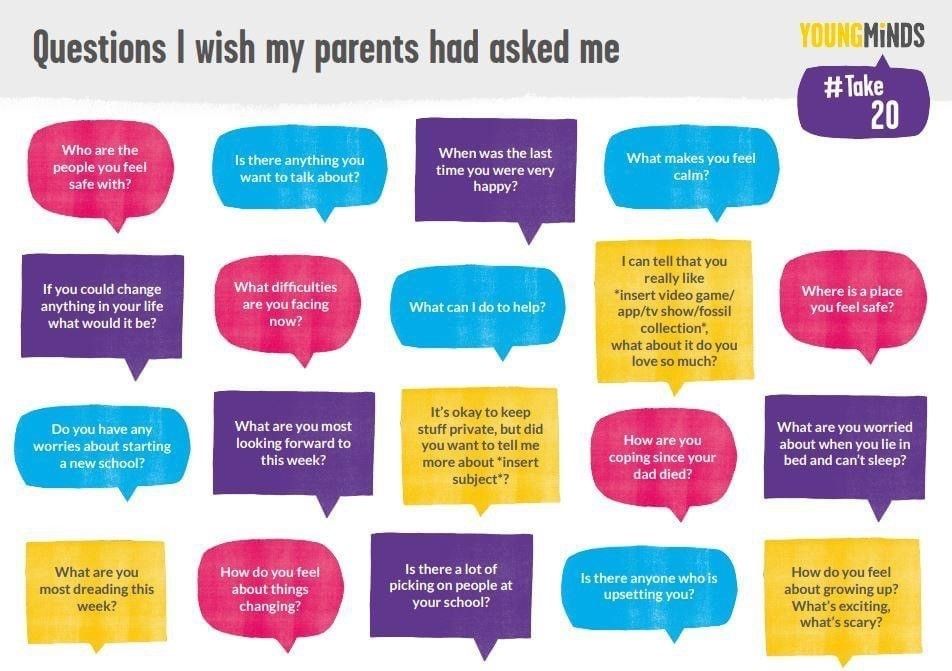
Young Minds and Mentally Healthy Schools have produced the following document, based on conversations they have had with young people, about helpful questions for parents to ask their child:
|
|
|
|
Just as we look after our physical health, so it is important to look after our mental health. Self-care is about what we can do to look after ourselves, to keep ourselves feeling ok, or to help ourselves feel better.
Everyone’s approach to self-care is different, but it is important that young people, and all of us, explore and develop strategies that work for us. Self-care does not have to be a big event - but it is important that we all find time to practise self-care.
|
|
Importantly, self-care is not a substitute for seeking professional support if needed.
There are so many ideas and suggestions for self-care that are available. Here are some common themes:
- Physical activities and exercise are important – they are a great way to relieve stress and help to centre or clear our mind.
- Relaxation techniques – practising breathing
- Time away from technology -leaving your phone behind, and time away from social media, can be of great benefit.
- Social activities – connecting with others, spending time with others brings with it many positive benefits to boost your wellbeing. Laughter really is good medicine!
- Music can be a great source of positivity. Listening to a favourite song, creating a playlist or listening to a happy song can all boost how someone is feeling. Music also helps to take your mind away – even for a short time – from worries.
- Gratitude – taking time to notice good things that have happened on the day and the blessings that we have, such as family and friends
- Self-kindness – taking time to do things you enjoy and taking time to recognise what you have achieved in the day.
- Organisation – setting achievable goals can give extra motivation and encouragement. Writing lists can help prevent stress.
- Routine – is helpful as a foundation for feeling good.
- Sharing concerns – either in person or via an online forum. It is important – and beneficial – to talk about any worries or concerns that you have.
The NHS has a series of videos available to support young people in looking after themselves and coping with worries: Self-care tips videos for young people - Every Mind Matters - NHS
The Anna Freud Centre has a booklet with top tips for young parents/carers - www.annafreud.org
Young Minds also has support for young people: Help With How I'm Feeling | Mental Health Advice | YoungMinds | YoungMinds
|
|
|
Tellmi is an award-winning early intervention mental health service. The service delivers fully moderated, evidence-based, anonymous, peer support to young people aged 11–25 years via an app.
The app allows young people to talk with others of a similar age and experience and provide each other with support, advice, empathy and a sense of belonging. When someone registers for the app, they are asked for a date of birth so that they are only shown posts from people of a similar age (2 years above and 2 years below).
|
|
The app has been approved by the NHS and the NHS deems the app safe for people as young as 11. The app has been independently evaluated by the Evidence Based Practice Unit at University College London and is evidenced to improve mental health in young people.
Users can anonymously post about anything that is worrying them and receive supportive replies from other people of a similar age. All posts and replies are checked by one of Tellmi’s team of trained moderators before being published. Moderation takes an average of 19 minutes. Moderation hours are from 8.30am to 11pm, so if someone makes a post or reply outside those hours, it won’t be published until the service opens again.
High-risk posts are redirected to the in-house counselling team for immediate support.
Tellmi features a comprehensive support directory with over 600 resources and educational resources and users can access 24/7 crisis support in two clicks. Both the feed and directory can be filtered by topic, eg ‘exams’, ‘friends’, which makes it easy for young people to join relevant conversations and access appropriate support.
For information about Tellmi’s approach to safeguarding, please visit www.tellmi.help/safeguarding. For more information about Tellmi generally, and to download the app, please visit the Tellmi website: www.tellmi.help/
|
|
|
The NHS and others have produced this tool to support people in taking care of their wellbeing:
|
|
|
|
|
This is a very current topic in the news, with Australia banning the use of social media for under 16s and politicians in the UK considering these issues here.
Before Christmas, the Children’s Commissioner, Rachel de Souza, issued this helpful information for parents in a digital advice guide
cc-what-i-wish-activity-pack-single-pages.pdf
Compass have written this commentary on the effects of mobile phones on young people’s mental health. You can read this here:
What effects do mobile phones have on children and young people's mental health - Compass
Other resources for parents include:
Smartphone Free Childhood
Children and technology: Age-appropriate usage advice | NSPCC
Screen time and phones: a guide to what works for your family
Supporting Children to Use Technology Intentionally
In today’s digital world, technology is an important part of learning, socialising, and entertainment. Helping children use it intentionally—with purpose and balance—can protect their wellbeing and improve focus, sleep, and relationships. Here are some practical ways parents can support this:
- Set clear boundaries together
Encourage children to have specific times for screens, like after homework or chores. Co-create rules around bedtime and device-free zones, such as mealtimes.
- Encourage purposeful use
Talk about why they are using a device: learning, connecting with friends, creativity, or relaxation. Help them distinguish between purposeful use and mindless scrolling.
- Model healthy habits
Children learn by example. Show them how you use your own devices intentionally, taking breaks and putting screens aside to focus on family, hobbies, or rest.
- Promote balance with offline activities
Encourage sports, reading, arts, and face-to-face interactions. The more fulfilling offline activities children have, the easier it is to use technology mindfully.
- Check in and discuss online experiences
Ask about what they do online and how it makes them feel. This builds awareness, encourages reflection, and supports emotional wellbeing.
- Use technology positively together
Play games, explore educational apps, or create digital projects as a family. Intentional shared experiences can turn screen time into meaningful opportunities.
By guiding children to use technology with purpose, parents help them develop healthy digital habits, strengthen focus, and support emotional and mental wellbeing.
|
|
|
SLEEP
Compass have also developed tips for supporting sleep routines. You can read this here:
Top tips for supporting your child's sleep - Compass
|
|
|
There is information available for parents and carers to support the wellbeing of young people:
Parents Mental Health Support | Advice for Your Child | YoungMinds
Information for supporting your young person's mental health | Mind, the mental health charity - help for mental health problems
Emotional Health Academy Young people, families and professionals can refer to the Emotional Health triage. You can find out more, and access the online referral form, at http://info.westberks.gov.uk/eha
|
|
|
|
|
|
|
There is lots of support available for students in school.
Form tutors are always the first point of contact for students. Students may also, of course, talk to their Head of Year and Progress Leader as well as the Assistant Heads who lead their Key Stage team. Our three Deputy Headteachers who work across the school are available for students as is Mr Linz, our Student Wellbeing Lead.
If students would prefer to make contact about wellbeing by email, we have a dedicated wellbeing email – smile@littleheath.org.uk which is monitored between 8am and 5pm on weekdays. Little Heath School website has a page dedicated to student wellbeing - Little Heath School - Student Wellbeing and there is a support form accessible from this page.
Since our return to school in 2021, we have asked all of our students to participate in a Tutor Wellbeing survey towards the end of each full term, where students give an update about how they are feeling through their responses to several questions. These surveys are then analysed by tutors and by the Pastoral team, and any additional necessary interventions are then put in place. Since we began these surveys, it has proved a really worthwhile and helpful process. The next Tutor Wellbeing survey will be after half term.
|
|
Time to Talk West Berkshire provides FREE confidential counselling services for young people in need, aged 11 to 25. If you need support and/or want to find out more, please email office@t2twb.org or call 01635 760331
|
|
Young Minds: Their website is full of advice and information to give young people the tools to look after their mental health. They empower parents and professionals to be the best support they can be to the young people in their lives. And they give young people the space and confidence to get their voices heard
|
|
Kooth: You can access support from other young people and professionals, all at your own pace
|
|
Stonewall: Support for LGBTQ+
|
|
Anna Freud: Self-care strategies for young people feeling low or anxious.
The Anna Freud Crisis Messenger text service is a free, confidential, 24/7 text message support service for anyone who is feeling overwhelmed or is struggling to cope. Their service is staffed by trained volunteers who will work with you to take your next steps towards feeling better.
If you need support, you can text AFC to 85258.
|
|
The Children's Society: Full of age-specific advice on issues that may be worrying children and young people
Emotional health and wellbeing for Young People
|
|
CAMHS in Berkshire (berkshirehealthcare.nhs.uk):
If you want to talk to someone about whether CAMHS is the right service to help, or if you are having extreme mental health difficulties and need support urgently, call the team on 0300 365 1234, 8.00am-8.00pm Monday to Friday. Outside of these hours, if you need urgent help, please contact the adult crisis team on 0300 365 0300
|
|
No5: Reading's young person's counselling and mental health support service for anyone between the ages of 11-25. They have been delivering free, professional, confidential counselling, outreach and mental health support to young people who live, work or study in the 'RG' postcode area since 1971.
|
|
NATIONAL HELPLINES
CHILDLINE
|
0800 1111
|
THE MIX
|
0808 808 4994
|
THE SAMARITANS
|
116 123
|
SHOUT
|
The UK’s 24/7 text service for anyone in crisis, anytime, anywhere. It’s a place to go if you’re struggling to cope and you need immediate help.
TEXT SHOUT to 85258
|
|
|
|