|
|
Welcome to our fourteenth “Little Heath School Wellbeing newsletter."
Our Wellbeing Newsletter is published three times a year, and we hope the information and advice in this issue is helpful.
This week is Mental Health Awareness Week. In this issue, as we enter exam season, we also look at some information about coping with exam stress.
|
|
|
|
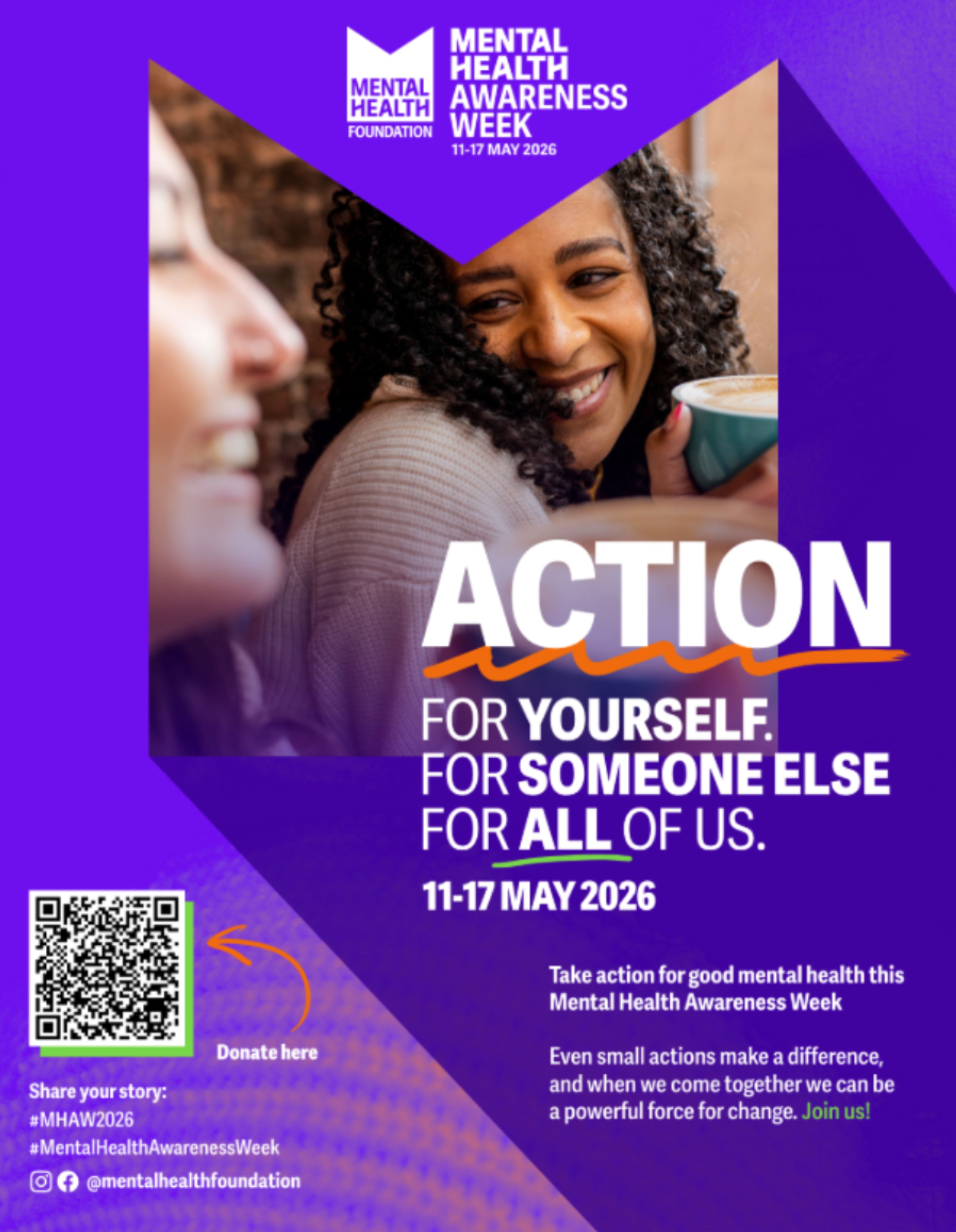
The theme for this year’s Mental Health Awareness Week, co-ordinated by the Mental Health Foundation, is ACTION.
The Mental Health Foundation says: This Mental Health Awareness Week we’re asking people to join us in taking action to support good mental health. Even small actions can help us feel hopeful and less powerless. And while our individual actions matter, when we come together we are even more powerful.
|
|
The Foundation asks all of us to find the one thing to boost our mental health. Choose one positive action that works for you.
The Mental Health Foundation has produced a series of tips to encourage people to support their own mental health. These tips can be found at: MHAW 2026 - Tipsheet 3: Top ten actions
Further information about Mental Health Awareness Week can be found at: Mental Health Awareness Week | Mental Health Foundation
Mental Health Awareness Week, with its theme of Action, is a valuable reminder that supporting wellbeing requires more than words—it calls for meaningful, everyday steps.
At Little Heath School, we want every student to feel supported, and able to thrive. We take action by fostering open conversations about mental health, and providing access to pastoral care and support networks.
|
|
Our staff are dedicated to recognising and responding to students’ needs, while encouraging resilience, kindness, and a strong sense of community.
Through these ongoing actions, we aim to ensure that every member of our school community knows they are not alone. Every action, from a warm welcome at the school gate to the collaboration between staff and families, strengthens the ties that help our young people feel safe, confident, and ready to succeed. We believe that when everyone works together, we create the best possible foundation for learning, personal growth, and lifelong wellbeing.
|
|
We will be marking this important week with a special assembly for Years 7-10 and Year 12 at the start of the week. We will also, of course, be reminding students about their avenues of support both inside and outside of school. We frequently talk with students and remind students about their avenues of support. We don’t want any students “suffering in silence” and there are several places that students can go within school should they wish to chat about how they are feeling.
|
|
|
Quick, easy daily habits are a great way to boost your mood and wellbeing.
The Mental Health Foundation offers ten quick actions to try that may improve your mood and mental wellbeing:
MHAW 2026 - Tipsheet 2: Quick actions
|
|
|
This list was written by young people around the country for Children’s Mental Health Week 2024:
-
Don’t keep it all to yourself and spend too much time in your own head. This can sometimes make it keep piling up, and make you feel worse.
-
Talk to someone you trust and feel comfortable with– a teacher, parent, sibling, cousin, friend... if you can’t think of anyone and need to talk, try talking to someone like Shout by texting SHOUT to 85258 for free.
-
Write your thoughts and feelings down.
-
Keep in contact with people, don’t isolate yourself.
-
Don’t dismiss your feelings because you think they aren’t valid. Everything you feel is valid and important to you.
-
Focus on the good parts of your life and doing what you love, rather than the negative.
-
Be your own best friend because, at the end of the day, you’re stuck with you – so look after yourself!
-
If you feel upset, then tell someone you trust and distract yourself in the meanwhile.
-
Do something you enjoy to help you relax and have a break – watch a film, play a game, watch your favourite YouTuber, listen to music.
-
Remember that you’re not alone, even if it sometimes feels like you are.
|
|
|
There is a lot of advice about supporting someone who is suffering from anxiety.
If you suffer with anxiety, you might like to try some of these suggestions:
- Talking to someone - Sharing how you feel can lift a load off your mind and release some of the tension of carrying around a burden.
- Writing down worries and keeping them in a particular place
|
|
- Change your physical setting – if you are feeling anxious, the act of moving to a different space can be hugely beneficial - for example, away from the computer or to a different room.
- Focus on Breathing - Deep breathing helps a major nerve which runs to your brain, called the vagus nerve, to send a message to relax and loosen up.Try this deep breathing exercise:
- Gently place a hand on your belly.
- Breathe in slowly through your nose, to a count of 4, feeling the air inflate your belly, pushing your belly slightly against your hand.
- Hold the breath for a count of 4 then slowly exhale for a count of 4, feeling your belly sink back.
- Repeat 3 times or until you feel calmer.
- Reframing thoughts - It’s not always easy, but trying to stay on the bright side keeps the anxiety from getting worse. This technique is called reframing and suggests you refocus any negative thoughts you might have as positives instead.
- Practising relaxation – not just in front of the screen! Have a hot bath, read, go for a walk, or do something fun. Relaxation can’t completely take away your anxiety, but it will help you deal with it better. Physical exercise is a great way to relax. Movement helps as you are taking the attention away from your mind and putting it into your body instead.
- Knowing triggers – be aware and know yourself. Make a list of your triggers and fears, so you can work on a plan of how to face them. Break the plan down into small steps, such as just going up to someone new and saying hi to deal with your fear of meeting new people.
- Sleep - anxiety can make it harder to go to sleep. Try and get into some good habits to help you drop off...avoid caffeine (especially later in the day), stick to the same sleep schedule, try meditation or a podcast, and avoid scrolling through devices an hour before bed.
|
|
|
As we begin the summer exam season, we thought it would be useful to signpost sources of support to help manage stress around exams. Common advice includes many of the tips in the section above. In particular, sleep, eating well, talking to someone, breaking revision down and having breaks in between revision, are all offered as important steps in the process of revision and exam preparation.
|
|
|
|
|
Tellmi is an award-winning early intervention mental health service. The service delivers fully moderated, evidence-based, anonymous, peer support to young people aged 11–25 years via an app.
The app allows young people to talk with others of a similar age and experience and provide each other with support, advice, empathy and a sense of belonging. When someone registers for the app, they are asked for a date of birth so that they are only shown posts from people of a similar age (2 years above and 2 years below).
|
|
The app has been approved by the NHS and the NHS deems the app safe for people as young as 11. The app has been independently evaluated by the Evidence Based Practice Unit at University College London and is evidenced to improve mental health in young people.
Users can anonymously post about anything that is worrying them and receive supportive replies from other people of a similar age. All posts and replies are checked by one of Tellmi’s team of trained moderators before being published. Moderation takes an average of 19 minutes. Moderation hours are from 8.30am to 11pm, so if someone makes a post or reply outside those hours, it won’t be published until the service opens again.
High-risk posts are redirected to the in-house counselling team for immediate support.
Tellmi features a comprehensive support directory with over 600 resources and educational resources and users can access 24/7 crisis support in two clicks. Both the feed and directory can be filtered by topic, eg ‘exams’, ‘friends’, which makes it easy for young people to join relevant conversations and access appropriate support.
For information about Tellmi’s approach to safeguarding, please visit tellmi | safeguarding. For more information about Tellmi generally, and to download the app, please visit the Tellmi website here: tellmi
|
|
|
Talking is important and can be a huge source of support. We would always encourage students to talk to someone they trust if they are, at any time, feeling worried, anxious, unhappy or sad.
|
|
When talking to others about their wellbeing and mental health, the Mental Health Foundation suggest:
- Finding a good space to talk without distractions
- Giving eye contact and full attention
- Listening and asking questions
- Asking how you can help
There is advice about how to prepare to talk to someone about their mental health and phrases to use and avoid. Please see Talking about mental health | Mental Health Foundation
The Young Minds website has a good deal of information to support parents/carers in talking to their children about mental health and wellbeing:
How to Talk to Your Child about Mental Health | YoungMinds
The website also has wider information to support parents/carers in looking after young people’s mental health:
Parents Mental Health Support | Advice for Your Child | YoungMinds
Mentally Healthy Schools have produced the following guide:
tips-for-having-a-conversation-with-a-child-about-mental-health.pdf (mentallyhealthyschools.org.uk)
Mind has the following support for parents in holding conversations with young people: Talking to an 11-18 year old about their mental health - Mind
The Children’s Society offers the following advice: GCR-2022-Well-being-Support Guide.pdf (childrenssociety.org.uk)
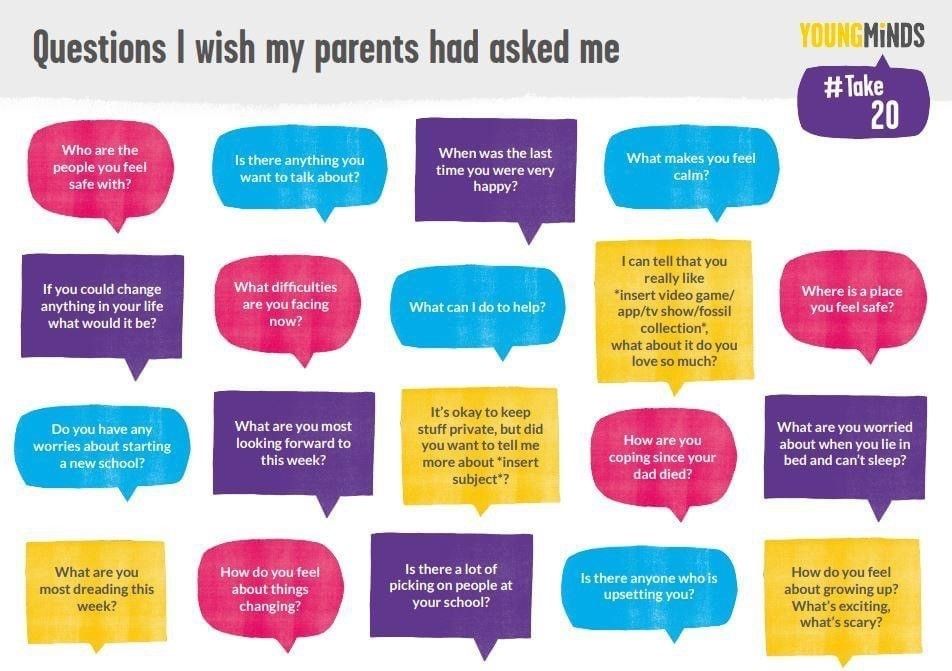
Young Minds and Mentally Healthy Schools have produced the following document, based on conversations they have had with young people, about helpful questions for parents to ask their child:
|
|
|
|
Just as we look after our physical health, so it is important to look after our mental health. Self-care is about what we can do to look after ourselves, to keep ourselves feeling ok, or to help ourselves feel better.
Everyone’s approach to self-care is different but it is important that young people, and all of us, explore and develop strategies that work for us. Self-care does not have to be a big event - but it is important that we all find time to practise self-care.
Importantly, self-care is not a substitute for seeking professional support if needed.
|
|
There are so many ideas and suggestions for self-care that are available. Here are some common themes:
The NHS has a series of videos available to support young people in looking after themselves and coping with worries: Self-care tips videos for young people - Every Mind Matters - NHS (www.nhs.uk)
The Anna Freud Centre has top tips for young parents/carers here: Self Care | Anna Freud
Young Minds also has support for young people: Help With How I'm Feeling | Mental Health Advice | YoungMinds | YoungMinds
|
|
|
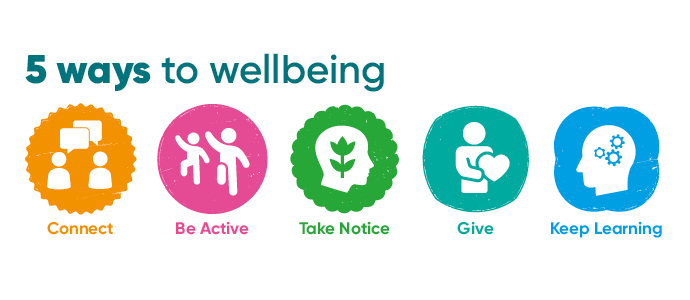
The NHS and others have produced this tool to support people in taking care of their wellbeing:
|
|
|
|
|
There is information available for parents and carers to support the wellbeing of young people:
Parents Mental Health Support | Advice for Your Child | YoungMinds
Information for supporting your young person's mental health | Mind, the mental health charity - help for mental health problems
Emotional Health Academy Young people, families and professionals can refer to the Emotional Health triage. You can find out more, and access the online referral form, at http://info.westberks.gov.uk/eha
|
|
Youngminds.org.uk | Anxiety
YoungMinds parents’ helpline for confidential, expert advice. You can reach them at 0808 802 5544
|
|
|
|
|
|
There is lots of support available for students in school.
Form tutors and Sixth Form mentors are the first point of contact for students. Students may also, of course, talk to their Head of Year and Progress Leader as well as the Assistant Heads who lead their Key Stage team. The Deputy Headteachers who work across the school and Mr Linz, our Student Wellbeing Lead, are also available for students.
If students prefer to make contact about wellbeing by email, we have a dedicated wellbeing email smile@littleheath.org.uk which is monitored between 8am and 5pm on weekdays. Please note that this email is for students only. The Little Heath School website has a page dedicated to student wellbeing - Little Heath School - Student Wellbeing and there is a support form accessible from this page.
Since 2021, we have asked all of our students to participate in a Tutor Wellbeing survey towards the end of each full term, where students give an update about how they are feeling through their responses to several questions. These surveys are then analysed by tutors and by the Pastoral team, and any additional necessary interventions are then put in place. Since we began these surveys, it has proved a really worthwhile and helpful process. The next Tutor Wellbeing survey will be at the end of June.
|
|
Time to Talk West Berkshire provides FREE confidential counselling services for young people in need, aged 11 to 25. If you need support and/or want to find out more, please email office@t2twb.org or call 01635 760331
|
|
Young Minds: Their website is full of advice and information to give young people the tools to look after their mental health. They empower parents and professionals to be the best support they can be to the young people in their lives. And they give young people the space and confidence to get their voices heard.
|
|
Kooth: You can access support from other young people and professionals, all at your own pace
|
|
Stonewall: Support for LGBTQ+
|
|
Anna Freud: Self-care strategies for young people feeling low or anxious.
The Anna Freud Crisis Messenger text service is a free, confidential, 24/7 text message support service for anyone who is feeling overwhelmed or is struggling to cope. Their service is staffed by trained volunteers who will work with you to take your next steps towards feeling better.
If you need support, you can text AFC to 85258.
|
|
The Children's Society: Full of age-specific advice on issues that may be worrying children and young people
Emotional health and wellbeing for Young People
|
|
CAMHS in Berkshire (berkshirehealthcare.nhs.uk):
If you want to talk to someone about whether CAMHS is the right service to help, or if you are having extreme mental health difficulties and need support urgently, call the team on 0300 365 1234, 8.00am-8.00pm Monday to Friday. Outside of these hours, if you need urgent help, please contact the adult crisis team on 0300 365 0300
|
|
No5: No5 is a community-based organisation offering counselling in Reading and support to young people and those around them. All No5 counsellors are members of a professional regulatory body who are fully qualified, or in their final years of a recognised professional qualification. Our counsellors come from all walks of life and backgrounds but all share a commitment to supporting young people.
Free Counselling In Reading | No5 | No5 - Free Counselling Services - Reading
|
|
NATIONAL HELPLINES
CHILDLINE
|
0800 1111
|
THE MIX
|
0808 808 4994
|
THE SAMARITANS
|
116 123
|
SHOUT
|
The UK’s 24/7 text service for anyone in crisis, anytime, anywhere. It’s a place to go if you’re struggling to cope and you need immediate help.
TEXT SHOUT to 85258
|
|
|
|